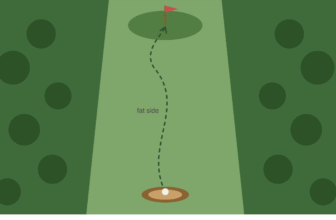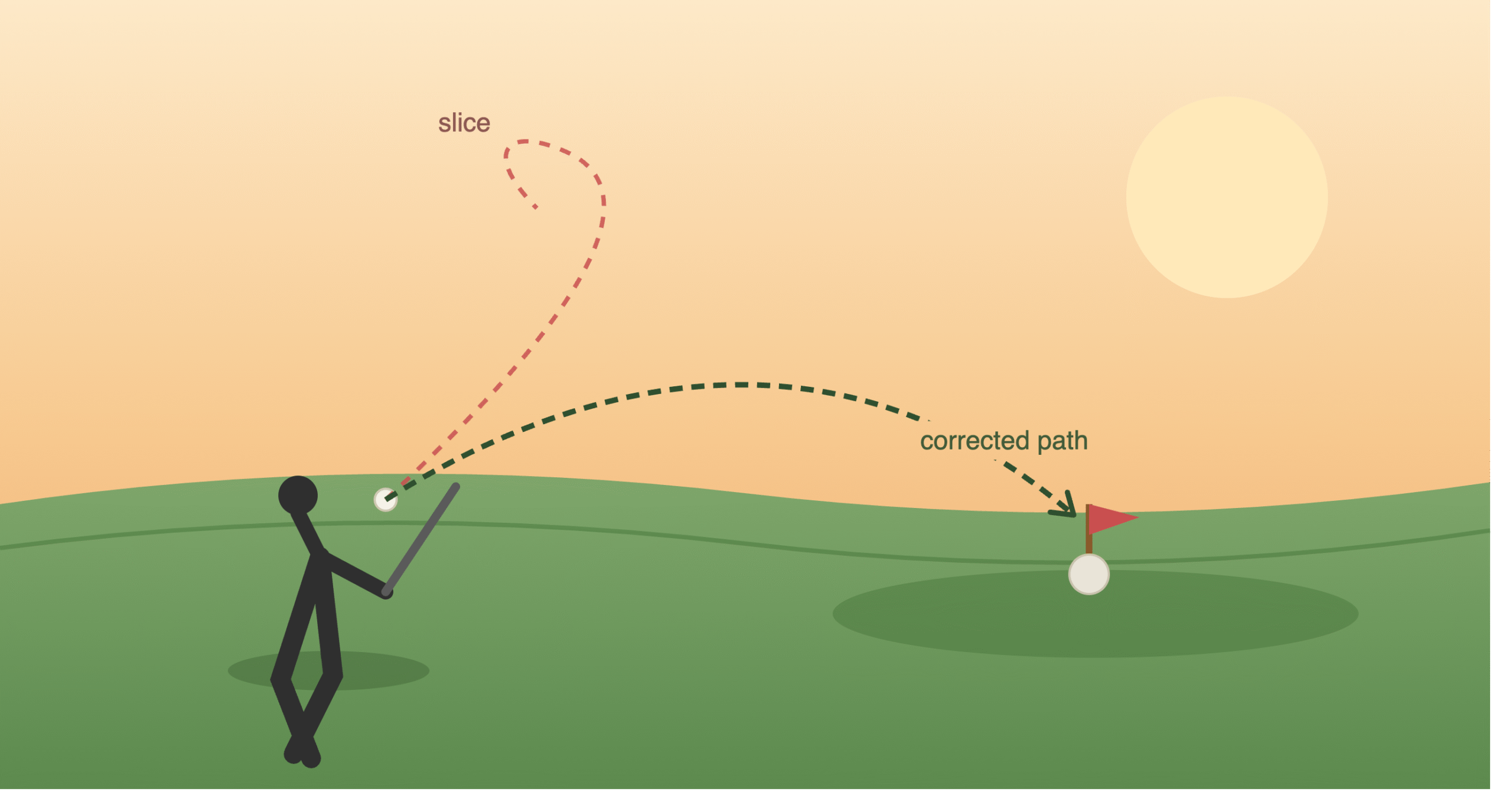
If your ball keeps curving hard to the right (or left, for lefties) every time you swing, you’re dealing with the most common miss in golf: the slice. The good news is that a slice isn’t a mystery — it’s a predictable result of clubface angle and swing path working against each other. Fix the root cause, and the fix sticks.
This guide breaks down exactly why a slice happens and gives you a step-by-step correction plan you can start using on your very next range session.
What Causes a Slice?
A slice happens when your clubface is open relative to your swing path at impact. In plain terms: your club is cutting across the ball while the face is still pointing right of where you’re swinging. That combination puts left-to-right spin on the ball, and the more open the face, the more it curves.
Three swing faults are usually behind this:
- An open clubface at impact — often caused by a weak grip
- An out-to-in swing path — the club cuts across the ball instead of swinging from the inside
- Poor weight transfer — hanging back on your trail foot instead of shifting toward the target
Most golfers have some combination of all three. Let’s fix them one at a time.
Step 1: Check and Correct Your Grip
A weak grip (hands rotated too far left on the club for right-handed golfers) is one of the biggest slice culprits, because it leaves the clubface open through impact without you realizing it.
How to fix it:
- Look down at your lead hand on the grip. You should see 2–3 knuckles, not just one.
- Your trail hand’s palm should face the target, not down toward the ground.
- A slightly stronger grip helps the clubface close naturally through the hitting zone.
This is a five-minute fix, but it takes repetition. Make the change at home, gripping a club a few dozen times a day until it feels normal.
Step 2: Fix Your Swing Path
If your path is out-to-in (cutting across the ball from outside the target line), you’ll slice even with a decent grip. The goal is to swing more from the inside.
Drill: The Headcover Gate
- Place a headcover or alignment stick just outside your ball, along your target line.
- Set up so a normal out-to-in swing would clip the headcover on the way down.
- Practice swinging so the club avoids it, approaching the ball from slightly inside instead.
Doing this drill at half-speed with short irons builds the feel of an inside path without needing full-speed swings right away.
Step 3: Improve Your Weight Transfer
Many slicers stay stuck on their back foot through impact, which stalls the hips and forces the arms to take over — usually resulting in that same out-to-in, open-face combination.
How to fix it:
- At the top of your backswing, feel your lead knee and hip start shifting toward the target before your arms start down.
- A simple checkpoint: at impact, roughly 80% of your weight should be on your lead foot.
- Practice with a “step drill” — take a small step toward the target with your trail foot right as you start the downswing, to feel the timing of the shift.
Step 4: Retrain Your Release
Once grip, path, and weight shift are improved, the last piece is making sure your forearms and hands rotate through impact (the “release”) instead of staying passive.
Drill: The Towel Swing
- Hold a towel or alignment stick with both hands like a golf grip.
- Make slow practice swings, focusing on rotating your forearms so the “clubface” closes through the impact zone.
- This trains the release pattern without needing a ball, so you can focus purely on the motion.
Step 5: Take It to the Range in Stages
Don’t try to fix everything in one swing. Work through corrections in this order:
- Grip check (a few swings)
- Path drill with headcover gate
- Weight shift step drill
- Combine everything at half-speed
- Full-speed swings once half-speed feels natural
Rushing to full speed before the new pattern feels automatic is the number one reason slice fixes don’t stick.
Quick Slice-Fix Checklist
- ✅ 2–3 knuckles visible on your lead hand grip
- ✅ Trail palm facing the target
- ✅ Swing path from slightly inside, not across the ball
- ✅ Weight shifting to lead foot before impact
- ✅ Forearms rotating through the release
Final Thoughts
A slice feels frustrating because it seems to happen randomly, but it almost always comes down to grip, path, and weight transfer working against each other. Fix those three in order, drill them slowly before taking them to full speed, and the slice that’s been haunting your scorecard will start to straighten out — literally.
The right equipment can help reinforce these changes too. A grip that fits your hand size properly makes it easier to hold the corrected position, and golf shoes with solid lateral support help you commit to that weight transfer without your feet sliding during the swing.